


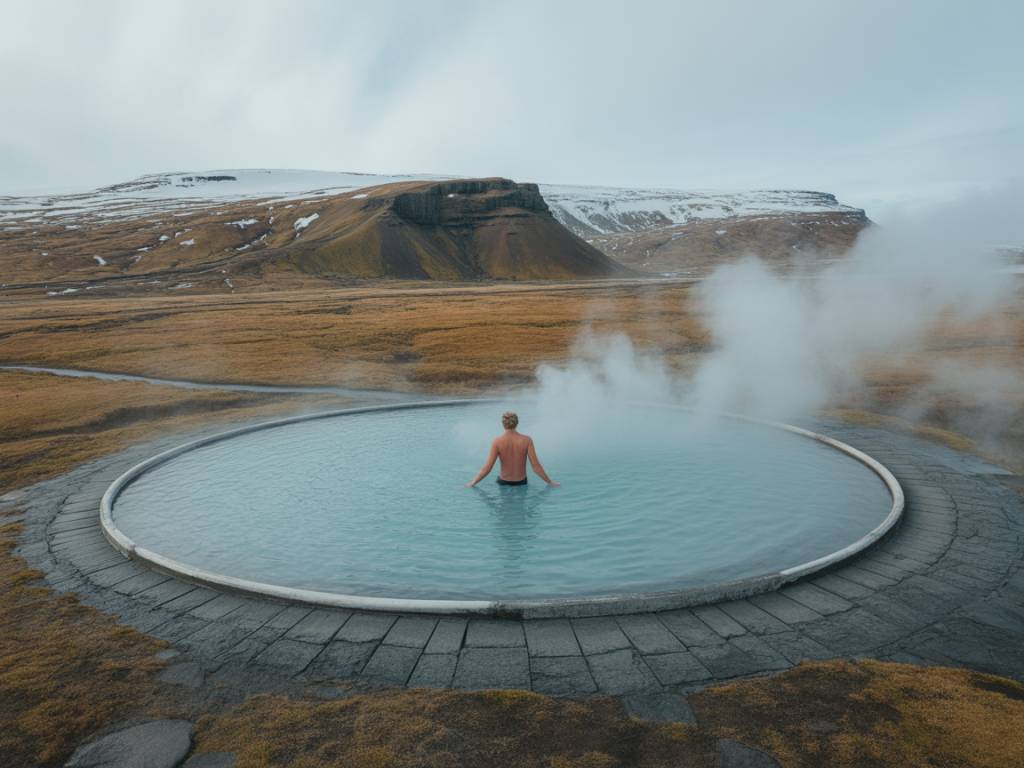
Sliding into a naturally warm pool in the middle of the Icelandic wilderness is still one of the purest experiences I know here. No changing rooms en dur, no ticket booth, just steam rising over lava fields, rivers, or fjords. But wild bathing in Iceland also comes with responsibilities, and I’ve seen enough damage and disrespect over the years to feel the need to spell things out clearly.
What makes a “natural hot spring” in Iceland?
When I talk about natural hot springs in Iceland, I usually mean three types of places:
- Truly wild pools: natural holes in the ground or small rock-built basins with no infrastructure, often on private land or in the highlands.
- Semi-developed pools: simple man-made basins, maybe a changing shelter and a pipe bringing hot water from a source nearby. Often run by farmers or local communities.
- Geothermal rivers: natural rivers where hot water mixes with cold water to reach a comfortable temperature.
Unlike the Blue Lagoon or Sky Lagoon, these places rarely have lifeguards, defined capacity, or clear signage. Temperatures can change, algae can make rocks slippery, and access tracks are often rough. That’s part of their charm, but also why preparation matters.
Essential rules and etiquette for wild hot springs
Before I share my favorite spots, I want to underline a few principles I always follow myself. The survival of these places depends on it.
- Ask permission when on private land: Many pools are on farms or grazing land. If there is a farmhouse nearby, I try to ask. A quick knock on the door in broken Icelandic or English is usually appreciated.
- Stick to existing paths and parking spots: The moss and tundra here can take decades to recover from one footprint. I never drive off-road and I avoid making new tracks on fragile ground.
- Never leave trash or “offerings”: That includes food scraps, coins, candles, cigarettes, or broken glass. I always pack a small bag to carry out not only my own waste but often what others left behind.
- Soaps and shampoos are a no-go: Even if they’re labeled “biodegradable”. These pools are often connected to small streams and ecosystems. I only use fresh water and clean up elsewhere.
- Respect nudity norms: Full nudity is less common outdoors than people expect. I usually wear swimwear in any public or semi-public place, out of respect for locals and other bathers.
- Keep noise down: Bluetooth speakers are, personally, one of the things I dislike most in wild pools. I try to keep conversations low and let others enjoy the silence or the sound of the river.
- Mind safety: I always test water temperature with my hand or foot first, avoid putting my head under in unmonitored pools, and stay away from unmarked boiling vents and fumaroles.
With that out of the way, here are some of the places where I’ve had the most memorable soaks, from accessible to very remote.
Reykjadalur: the classic hot river near Reykjavík
If you only have one day and want to experience a natural hot river, Reykjadalur (“Steam Valley”) is still an excellent introduction. It is also, admittedly, far from secret. Over the years I’ve watched it change from a mostly local hiking spot to one of the most visited geothermal valleys in the south.
The hike from the parking lot above Hveragerði takes about 45–60 minutes each way. The trail climbs steadily, passing bubbling mud pots and steaming vents. I always recommend good hiking shoes: the path can be muddy and windy, and weather changes fast.
At the river itself, simple wooden platforms and modest partitions make changing slightly easier, but it’s still very exposed. The higher upstream you go, the hotter the water. My personal trick is to walk slowly along the banks, test a few sections with my hand, and settle where cold water flows in from the side.
Despite the crowds in high season, I still like Reykjadalur early in the morning or in shoulder season. When the mist hangs over the hills and the wind drops, you can still feel how wild this valley once was.
Landmannalaugar: bathing among rhyolite mountains
Landmannalaugar literally means “the people’s pools”, and it has earned its name. After a day of hiking among colorful rhyolite peaks, soaking here feels almost unreal.
The pool itself is a natural warm river widened into a shallow basin just beyond the mountain hut and campsite. Temperatures vary depending on where you sit; I tend to move around until I find a sweet spot, slightly closer to the hot inlet but not right on top of it.
Reaching Landmannalaugar requires planning. In summer, you’ll need a 4×4 or a bus that can cross the rivers, and the F-roads are only open for a short window. I avoid driving a low-clearance car here; the river crossings are not just photo opportunities, they’re genuine obstacles.
I recommend treating Landmannalaugar more as a base for hikes than just a “stop to see a hot spring”. The pool is wonderful, but what makes it special to me is the context: sulfur-smelling steam, black lava fields, orange and green hills all around.
Hrunalaug: a charming farm hot spring (with rules)
Hrunalaug near Flúðir is one of those places that Instagram made famous very quickly. I remember visiting when it was still mostly unknown outside Iceland; now, it has a paid entrance system and clear rules to protect it. Personally, I’m glad some form of management was introduced rather than letting it be destroyed by overuse.
The small stone pools and turf-roofed shelter make Hrunalaug feel like something out of a fairy tale. The water is comfortably warm, not too hot, and the capacity is limited – this is not a place for big groups or noisy gatherings.
When I go, I try to visit early or late, and I accept that I might need to wait my turn or even skip it if it’s already packed. Respecting the landowner’s rules and payment system is, in my view, non-negotiable here. These tiny pools simply cannot handle heavy traffic without some control.
Seljavallalaug: legendary pool in a dramatic valley
Seljavallalaug is often described as a hidden pool, but it’s one of the most documented spots in the south. Built in 1923 at the foot of steep mountains, it feels more like an abandoned pool reclaimed by nature than a wild hot spring, yet it still has a raw charm I appreciate.
The short walk from the parking lot follows a valley carved by glacial rivers, with black scree slopes on either side. The pool itself clings to the mountainside, partly filled by hot water and partly by cold runoff. This means the temperature can be on the cool side, especially in shoulder seasons.
There is a basic changing room on site, but no upkeep other than what volunteers occasionally do. I always set expectations correctly: the water can be murky, algae grows on the floor, and you share it with whoever shows up. For me, the real attraction is the location, not spa-like comfort.
Hellulaug: soaking by the sea in the Westfjords
Hellulaug is one of my personal favorites and a spot where I still feel that mix of isolation and comfort that I look for in wild bathing. It’s located right by the road on the southern coast of the Westfjords, yet it rarely feels overcrowded compared to the south coast hotspots.
The pool is a simple rock basin at sea level, filled by a hot spring that keeps the water pleasantly warm. You sit there looking out at the fjord, with the possibility of dramatic weather changing the mood in minutes. There are no buildings, no changing rooms, just a small parking place above.
Because of its exposure, I pay extra attention to wind and waves here, especially in winter. I also find it particularly important to keep a low profile: locals use it too, and it still feels like a shared secret rather than a tourist “attraction”.
Krossneslaug: the edge-of-the-world pool
For those willing to drive to the far northeast of the Westfjords, Krossneslaug offers one of the most spectacular pools in Iceland. Technically, it’s a community pool with a building and showers, but the setting is so remote and rugged that I still include it when I think about wild bathing.
The rectangular pool sits right above the shoreline, with waves crashing below and a vast view of the Greenland Sea. On a calm evening, soaking here while the sky slowly turns pink is something I’ve rarely seen matched elsewhere.
To get there, be prepared for a long drive on gravel roads that can be rough on small cars. I always check road conditions beforehand (especially in early summer and autumn) and avoid rushing; the journey itself is part of the experience.
Hidden and lesser-known pools: how I look for them
Readers often ask me for “secret” hot springs. Over time, I’ve become more cautious about naming truly delicate spots publicly; some of them are already suffering from erosion, trash, and social media exposure.
Instead, I prefer to share how I look for them:
- Talk to locals: Guesthouse owners, farmers, and café staff sometimes suggest smaller pools that don’t appear in guidebooks. I don’t geotag them online out of respect.
- Use maps, not just Instagram: Detailed maps and official geothermal surveys sometimes indicate “hot spring” or “laugar” in place names. I cross-check these with local advice to see if they’re safe and accessible.
- Accept that some places are off-limits: A natural hot spring on private land is not automatically a tourist destination. If there is a fence, a clear “no entry” sign, or sensitive vegetation, I walk away.
- Be ready to backtrack: I’ve hiked to several promising spots and decided not to bathe because the ground was unstable, the water smelled strongly of sulfur, or the temperature was unpredictable.
Some of the less-publicized but still relatively accessible places I personally like include small farm-run pools in the north and east, or unnamed hot spots near geothermal areas where locals have built tiny rock basins. I tend to keep those vague on purpose, hoping they’ll remain low-impact places rather than the next viral location.
Practical tips for enjoying Iceland’s natural hot springs
To make the most of these wild or semi-wild baths, I usually follow a simple checklist:
- Pack a small microfiber towel and a dry bag to keep clothes safe if there’s no changing room.
- Bring flip-flops or water shoes for rocky or slippery entries.
- Have a warm layer and windproof jacket ready for when you get out; the chill hits fast when you’re wet.
- Carry a headlamp if you plan a soak at dusk or in winter – trails are rarely lit.
- Check road and weather conditions before driving to remote pools, especially in the Westfjords and highlands.
- Always allow extra time; rushing a visit to a remote hot spring usually leads to poor decisions.
For me, the real luxury of Iceland’s natural hot springs has never been about fancy facilities or flawless water. It’s about the simple idea of sitting in warm water while the wind, snow, or midnight sun sweeps across the landscape. If we treat these places carefully – as guests rather than consumers – they can continue to be part of what makes traveling in Iceland feel genuinely special.