


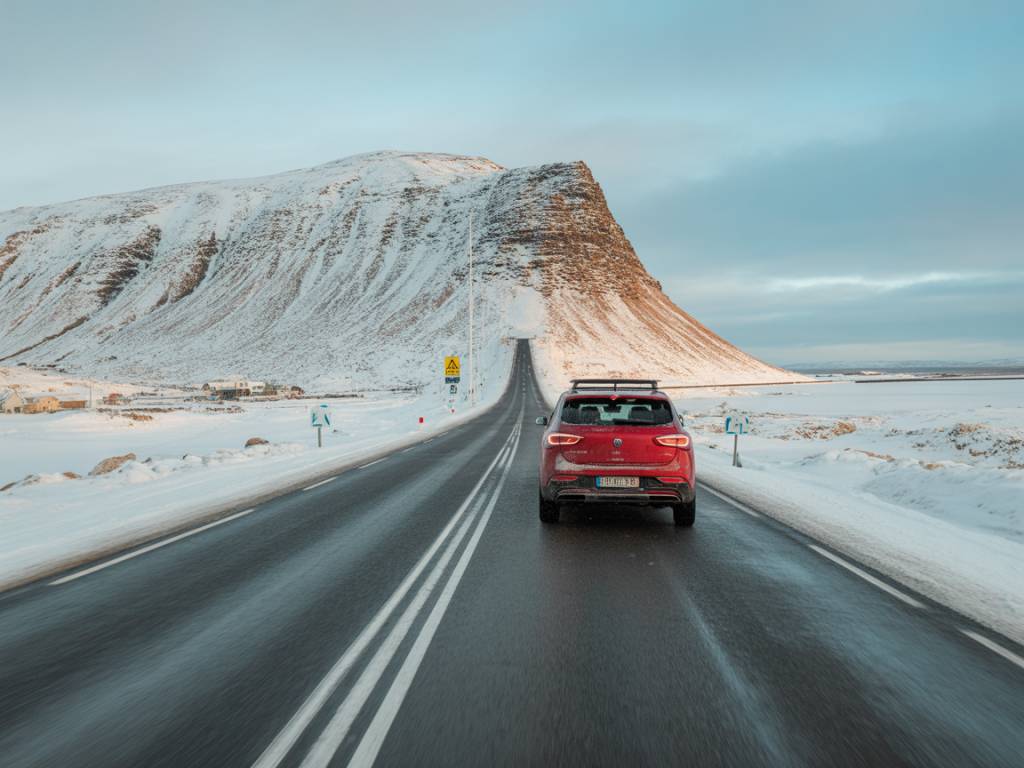
Understanding Icelandic winter driving conditions
When I first drove in Iceland in winter, I quickly realized that this is not just “cold weather driving” as I knew it from mainland Europe. It is an entirely different environment, shaped by the North Atlantic, fast-changing weather systems and long, dark days. If you are planning a winter road trip here, it’s essential to understand that conditions can be challenging, unpredictable and, at times, genuinely dangerous.
Winter in Iceland typically runs from late October to April, though snow and ice can appear earlier or linger later. Roads can shift in a matter of minutes from wet to icy, from clear to completely hidden under blowing snow. A stretch of road that seems manageable at 10:00 can become nearly impassable by midday when a storm rolls in.
In coastal areas such as Reykjavík and the South Coast, you might experience relatively mild temperatures hovering around freezing, often with slush and black ice. In the north and in the interior, it gets significantly colder, snow conditions are more severe and winds can be brutal. I’ve had days where I started on bare asphalt and ended up in a full whiteout an hour later, questioning every decision that led me onto that road.
Legal requirements for driving in Iceland in winter
Before getting into techniques and practical advice, it’s worth reviewing what the law expects from you as a driver in Iceland during the winter months.
First, headlights must be on at all times, day and night, regardless of weather or season. This is strictly enforced and, in my experience, also absolutely necessary. In low light or blowing snow, vehicles without headlights become almost invisible in seconds.
Seat belts are mandatory for everyone in the car. There is zero tolerance for driving under the influence of alcohol or drugs; the legal limit for blood alcohol content is very low (0.02), and checks are frequent, especially around holidays.
From roughly November to mid-April (exact dates can vary slightly), cars must be equipped with winter tires. Most rental cars will automatically have them, but I always double-check at the counter, especially if I’m planning to leave the city. Studded tires are common and highly recommended for icy conditions.
Another important legal aspect is road access. Many mountain roads (F-roads) are completely closed during winter; ignoring these closures is illegal and dangerous. The same goes for temporary closures on main roads: when the authorities close a road because of strong winds, snowstorms or poor visibility, attempting to drive it anyway can result in fines—and, more importantly, rescue operations that put others at risk.
Choosing the right vehicle for winter driving
In winter, the choice of vehicle in Iceland is not just a matter of comfort; it can determine whether you reach your destination safely or end up stuck in a snowdrift waiting for help.
If you plan to stay in Reykjavík and do only short trips on main roads, a small 2WD car with good winter tires can be enough. However, for almost any route that includes the South Coast, Snæfellsnes, the North or the Westfjords in winter, I personally prefer a 4×4 (4WD) vehicle.
Here is how I think about it when I book a car:
Transmission is another factor. Even if you’re used to manual gearboxes, an automatic can make winter driving less stressful, allowing you to focus on the road instead of shifting gears on slippery surfaces.
Finally, I always ask the rental company about:
Essential safety habits on icy and snowy roads
The first rule I follow when driving in Icelandic winter conditions is simple: slow down. The official speed limits are:
However, these limits are maximums, not targets. In snow, ice or strong winds, I often drive far below them. It may be frustrating if you are used to making “good time” on road trips, but here, arriving late is always better than not arriving at all.
On icy roads, I keep all movements smooth and gentle:
Black ice is a particular danger in Iceland. It often forms on bridges, shaded sections and near coastal areas where moist air meets cold surfaces. Many of the worst accidents I’ve heard about involved drivers who didn’t realize they were on ice until it was too late.
Bridges also deserve special mention. A lot of them are:
On a single-lane bridge, the general rule is that the first car to reach the bridge has right of way, but I always slow down, make eye contact with oncoming drivers if possible, and only proceed when it’s clearly safe.
Using Iceland’s road and weather information tools
Winter driving in Iceland is as much about preparation as it is about handling the car. Two websites have become my constant companions here: the Icelandic Road and Coastal Administration site (road.is) and the national weather service (vedur.is).
On road.is, I check:
On vedur.is, I look at:
My routine during a winter road trip in Iceland is to check both sites in the morning before departure, then again at lunch and mid-afternoon. Conditions can change quickly, and I’ve had days where an afternoon check persuaded me to stop earlier than planned and stay in a small town rather than push on into a developing storm.
Planning your itinerary with winter realities in mind
One of the most common mistakes I see visitors make is to underestimate driving times and overestimate what they can see in a single winter day. Distances that seem modest on a map—say 200 to 250 km—can feel very long when it’s dark, windy and snowing, and when you’re constantly slowing down for icy patches.
When I plan a winter route, I usually:
For first-time winter visitors, I often recommend:
Short winter days also change the rhythm of travel. In December and early January, you may get only 4–5 hours of usable daylight in parts of the country. Driving in darkness on icy roads can be disorienting and tiring, so I aim to cover the most difficult stretches during daylight and keep night driving to a minimum.
Dealing with strong winds and storms
If there is one element that has consistently surprised me here, it is the wind. Icelandic wind is not just a strong breeze; it can be powerful enough to blow car doors open violently, push vehicles sideways and create sudden whiteouts with blowing snow.
When the forecast warns of strong winds, I adjust my plans. I’ve canceled or shortened driving days when gusts were predicted to exceed 20–25 m/s, especially in exposed areas on the South Coast and in the north. Rental companies sometimes advise against driving in certain regions on very windy days, and I take that advice seriously.
Some practical habits I’ve adopted:
What to keep in the car in winter
Even on well-traveled roads, winter conditions can delay you or force you to stop for longer than expected. I like to think of the car as a small survival capsule and carry a few basic items just in case.
In my winter rental car, I usually have:
Most of the time, these items stay in the trunk, unused. But on the rare occasions when I’ve had to stop in heavy snow or wait for a cleared road, I’ve been glad to have them within reach.
Knowing when not to drive
Perhaps the most important skill for winter driving in Iceland is knowing when to step back and say, “Not today.” As travelers, we often feel pressure to stick to plans, reach the next hotel booking or “make the most” of our time. Iceland’s winter, however, does not care about our schedules.
On one memorable trip, I watched the weather warnings go from yellow to orange overnight. The road webcams showed near-zero visibility and strong winds on the stretch I had planned to drive. I canceled my departure, booked an extra night where I was and spent the day walking around a small town instead. I arrived at my next destination 24 hours late—but safely, and with a good story about the day I decided the storm would win.
Listening to local advice is invaluable. If your guesthouse host, a gas station attendant or your rental company tells you that driving is a bad idea today, I would take that more seriously than any itinerary you’ve made in advance.
Winter driving in Iceland demands humility, patience and preparation. For those willing to adapt and respect the conditions, it can also be incredibly rewarding: empty waterfalls in the snow, northern lights above frozen lakes, quiet roads winding through landscapes that feel almost otherworldly. I keep coming back in winter not despite the challenges of the road, but partly because of them—the journey itself becomes an essential part of the Icelandic experience.